August 6, 2026
Does an ADU need its own gas and electric meter? I called Avista.
A week ago I wrote that permitting my ADU would cost $1,000 to $2,000 and that the one number I still didn't have was power and gas. I said I'd post Avista's number the day I got it.
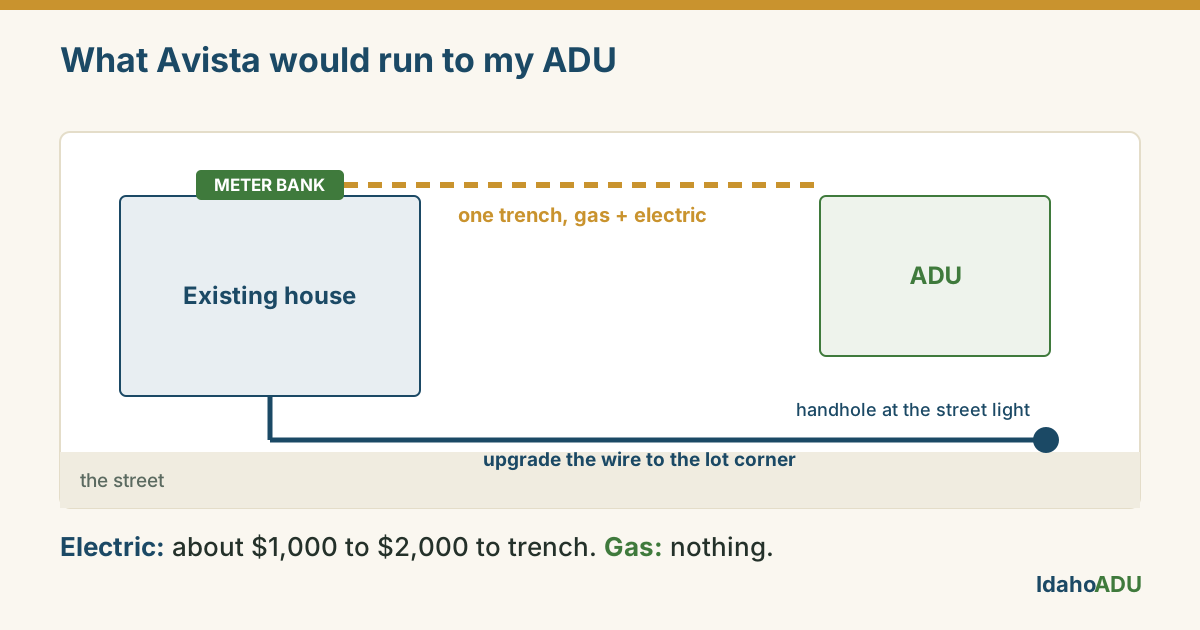
I got it today. Electric: about $1,000 to $2,000 to trench across my property and upgrade the wire. Gas: nothing.
Then I asked about my other property, across town in the same city. Almost none of it applied there.
Does it even need its own meters?
I assumed the ADU would need its own meters. It turns out that depends on where you are.
Coeur d'Alene requires it. An ADU there has to have its own address and its own gas and electric meters. Post Falls doesn't. I emailed the city and got an answer back the next day. Hook the ADU up to the house utilities or don't, it's my call. Avista's own position is the same, that both units can run off one meter if the local code allows it.
There's a catch in Post Falls' answer. Separating any of the ADU's utilities from the house's needs extra review and approval from the Planning Department, and that depends on lot size, orientation and zoning. For water and sewer it also costs about $11,000. I'm still working out whether the way Avista wants to wire my lot counts as separated at all.
So the planner I talked to turned the question around on me. Do I want them metered separately, so I can bill separately?
Yes. Even if Post Falls says I don't have to.
If somebody rents the ADU I want them paying their own power bill, not a number I guessed at and buried in the rent.
One detail to put in your math while you're deciding: every meter carries a $20 a month basic charge whether anybody uses it or not. He told me that on the phone and I went and checked it against Avista's published Idaho rates, which is where you can check it too. It's $20.00 on Schedule 1 residential electric (rate sheet, effective May 1, 2026) and $20.00 on Schedule 101 gas (rate sheet, effective January 1, 2026).
Two extra meters is about $40 a month. Every other number on my ledger is a one-time cost.
What's happening on my lot
The north side of my house already has two meters on it, so that's where everything goes: a two-meter manifold for gas, a two-meter pack for electric, all in the same spot.
That grouping isn't optional. Meters have to be together. You can't put one on the north side of the house and another on the south side. Gas meters go with gas meters and electric with electric, and Avista would rather have all of it in one place.
From there they'd run underground to the ADU, gas and electric in the same trench.
The electric side needs a capacity upgrade. The wire from the house out to the corner of the lot gets replaced, out to an underground handhole by the street light. That means a trench across the property, and that's the $1,000 to $2,000. He called it a rough number, so I'm treating it as one until something shows up in writing. What I end up with is two 200-amp services.
The gas manifold and the new meters themselves are no charge.
The gas side
My gas line is plenty sufficient for anything you can throw at it, according to the Avista guy, so there's no need to upgrade the gas service.
I got lucky on that one. You would have to check on your gas service capacity by asking Avista.
Add up the BTU demand of every gas appliance you'll have, across both units. Compare it to what the line can carry. If the total fits, you're done. If it doesn't, the line must be upgraded.
Upgrading the line that feeds the meter costs money. Swapping the meter itself doesn't. But if the meter gets swapped, the gas gets disconnected in the process, and a qualified professional has to reconnect it, so that's another bill.
My other property got a different answer
I own another property in Post Falls, and I asked about that one too.
Same city. Same utility. Almost nothing in common.
That lot has no real spare gas capacity. Serving an ADU there would mean upgrading the line all the way back to the alley. Its electric is overhead, not underground, with poles and transformers on the corners, so the whole approach changes: you'd put the meter pack on the ADU and have an electrician run back to the house from there. Converting overhead to underground is another $1,000 to $2,000 in fees on top.
Judging by just these two properties, you can see that the answers are very site dependent.
So if somebody tells you what an ADU costs to hook up, ask them which lot they're talking about.
Where the big money is
I asked what makes these jobs expensive.
New transformers are expensive. Extending primary high voltage is expensive. He didn't give figures and I didn't push, because neither applies to me. If either one applies to you, your project is a different project.
Overhead to underground runs $1,000 to $2,000 in fees.
Don't dig your own trench. I asked about that, figuring I'd save some money. He said let them do it. You might save $200, and the trench has to be inspected, which drags the timeline out. I'm taking his advice.
How can I find out for myself?
I asked whether I could look any of this up myself before calling. What's in the ground under my own lot, where the gas main runs, what the line carries.
No. Avista has maps of its gas and electric facilities and they're internal.
I don't think that's unreasonable of them. But it does mean you can't answer "will this even work on my lot" on your own. You call, you give them the address, you wait for somebody to go look. That's fine when it's one call about one lot. I keep wondering how many people never make the call at all.
The guy I talked to covers Post Falls and Rathdrum, and the other 4 or 5 people in it cover other areas of the county. They've been expanding because the area is growing. He said new subdivisions are the easy work because they're all the same. The hard work is old systems and downtown revitalization, in both Post Falls and Coeur d'Alene. And it sounds like older means harder.
Still open
- Does Post Falls require an ADU to have its own street address?
- What counts as separated from the house utilities?
- No firm quote yet on the trenching.
- Avista prepared paperwork for my address and I don't know what's in it.
Everything above is on the project tracker, which is where I keep the running total. If you've been through this with Avista and got a different answer, or a number that turned out very different from the estimate, I'd like to hear it. Leave a comment below or use the contact form.
Source: phone call with an Avista service planner covering Post Falls and Rathdrum, August 4, 2026, on Avista construction case #00394233.
Comments